


Contact
General Inquiries
If you have any questions related to our products, the Koehler sales team will be happy to help. Just send us your inquiries using our contact form.
This e-mail service is intended exclusively for wholesalers, paper converters, printers, agencies, and graphic-design offices. We hope you will understand that we will not be able to respond to enquiries from private individuals.
Koehler Worldwide
For international product inquiries please contact our sales Partners.
Field of action 4
Pulp Ahoy!
Inland waterway transport is the most sustainable means of transporting pulp from the Netherlands to the Black Forest.
The main things we need to make our paper products are pulp fibers and water. And while we have the latter in abundance right at our front door, pulp is usually a bit farther away. That means it needs to travel to us, and it also means it is our responsibility to make that trip as sustainable as possible. A travelogue.

“We transport 150,000 metric tons of pulp a year to Kehl.”
Matthijs Mannak Interrijn Director
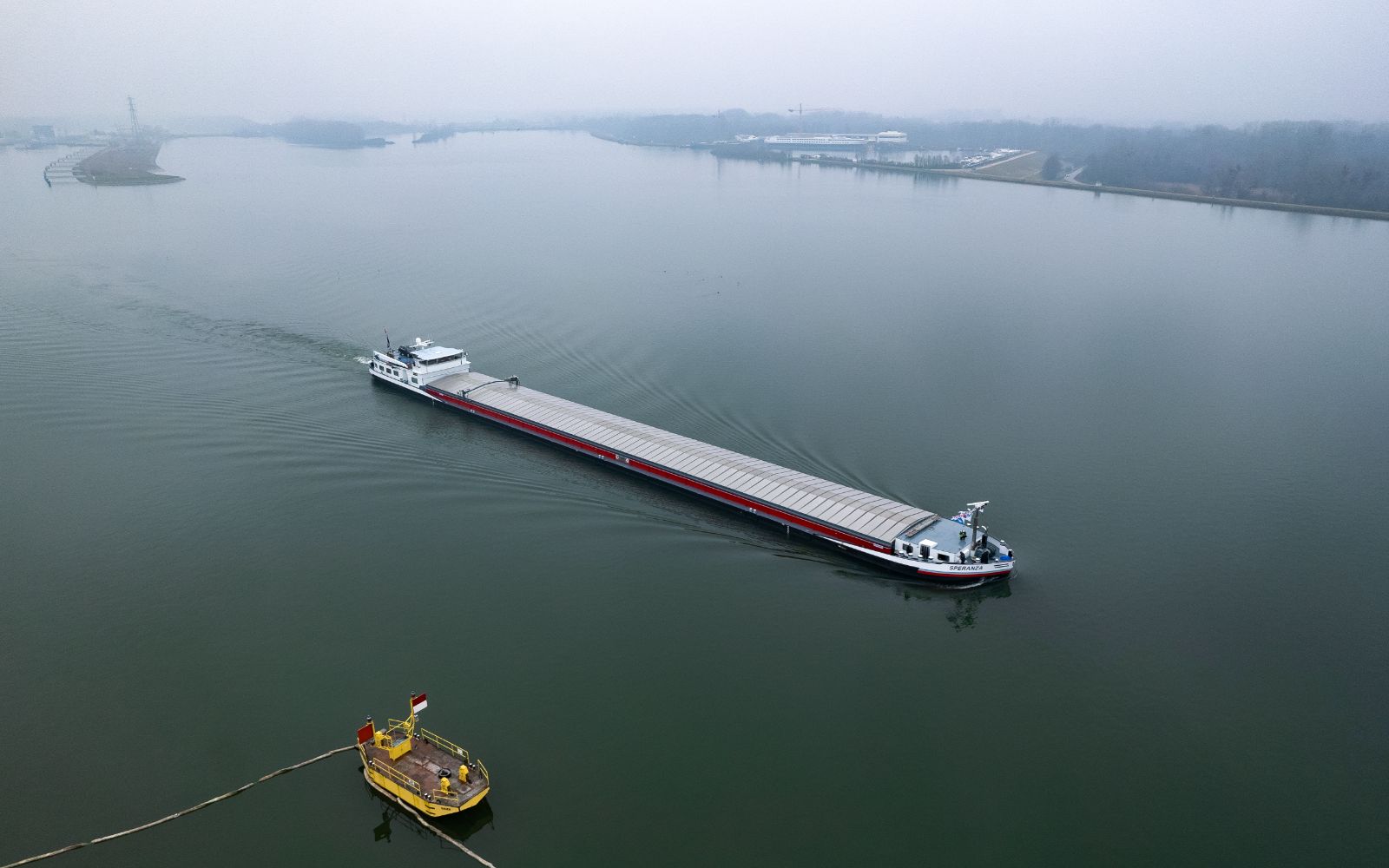
The bright red “Speranza” plows silently through the dull, grayish-green waters of the Rhine. It has been traveling “uphill” for six days now, as Rhine riverboat skippers like to call the trip upstream. The ship just passed the Gambsheim lock, where two passengers climbed aboard with the intention of going all the way to the last stop, Kehl. Their names are Marc Lienhard and Matthijs Mannak, and while they often have conversations on the phone, talking in person is what they clearly like best – and today they are doing that on water. Lienhard is the Corporate Director of Logistics and Process Management of the Koehler Group in Oberkirch, while Mannak is the Director of logistics service provider Interrijn in Zwijndrecht, in the Netherlands. Another hour and a half to go before the boat gets to Kehl.
On Course for Kehl
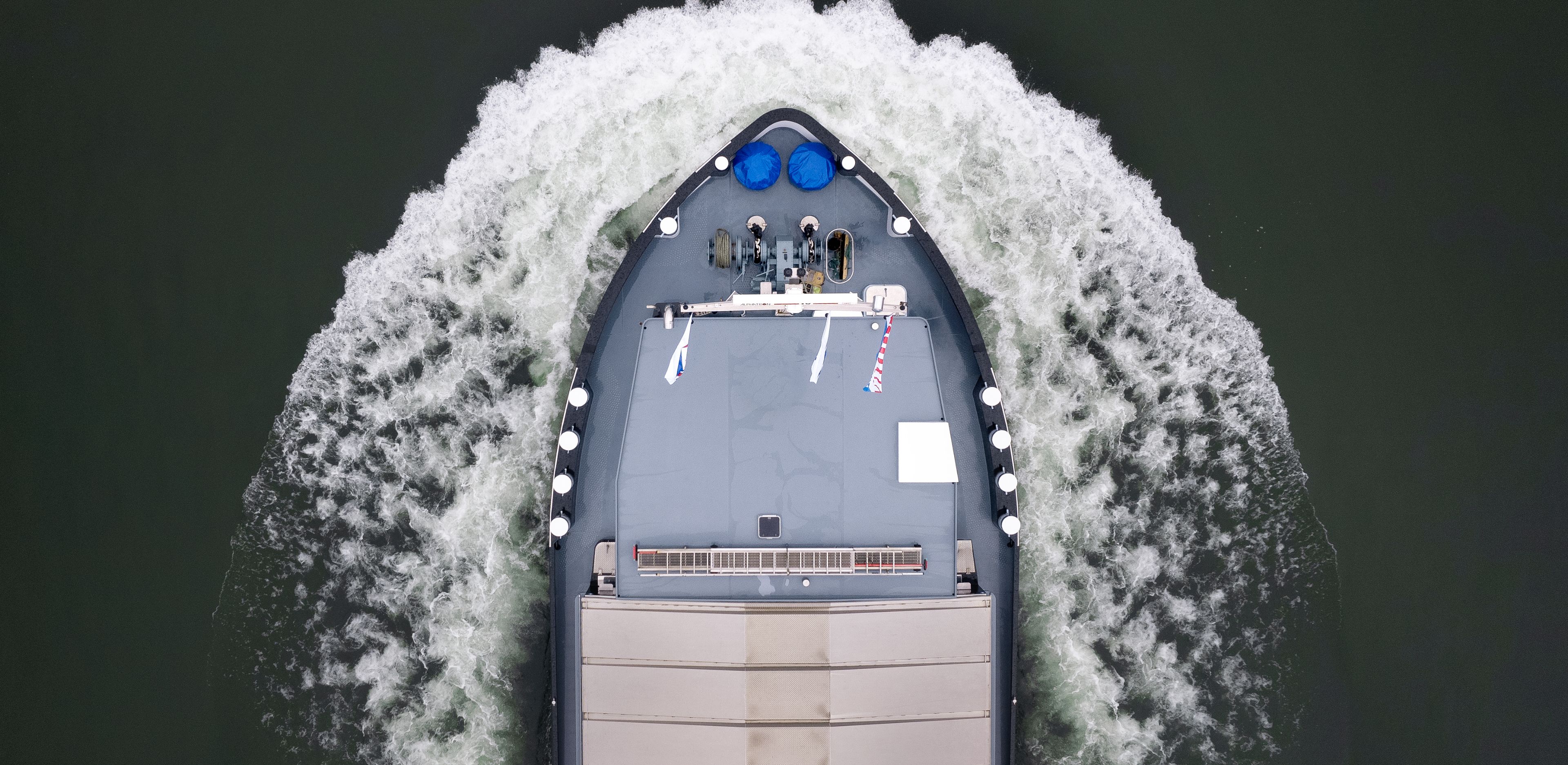
From the bow, they take a good look at the 110-meter-long Speranza. Their eyes stop at the long roof, which keeps the cargo space dry. In it are 8,000 pulp bales that already have a long journey behind them. Eight weeks ago, a cargo ship in South America took these bales on board and brought them across the Atlantic. In the Dutch harbour of Vlissingen, the valuable raw material was transshipped from the large ocean freighter to Interrijn’s riverboat. The port at the mouth of the Scheldt into the North Sea is an important handling trans-shipment center for pulp shipments from all over the world. While the boat glides toward Kehl, Mannak takes a look at the bow wave and remarks: “We ship pretty much everything except liquids. Bulk cargo such as corn, coal, and cement, but also things like steel and tractors – and, of course, pulp. Almost every week, one or two of our ships are underway for Koehler. We transport a total of roughly 150,000 metric tons of pulp to Kehl every year.” When asked how long Koehler and Interrijn have been working together, the two laugh heartily, think for a second, and then give it their best guess: “Since forever?” Mannak stops to really think about it and then gives a more concrete number – around 40 years, or at least that is what his most senior employees say.
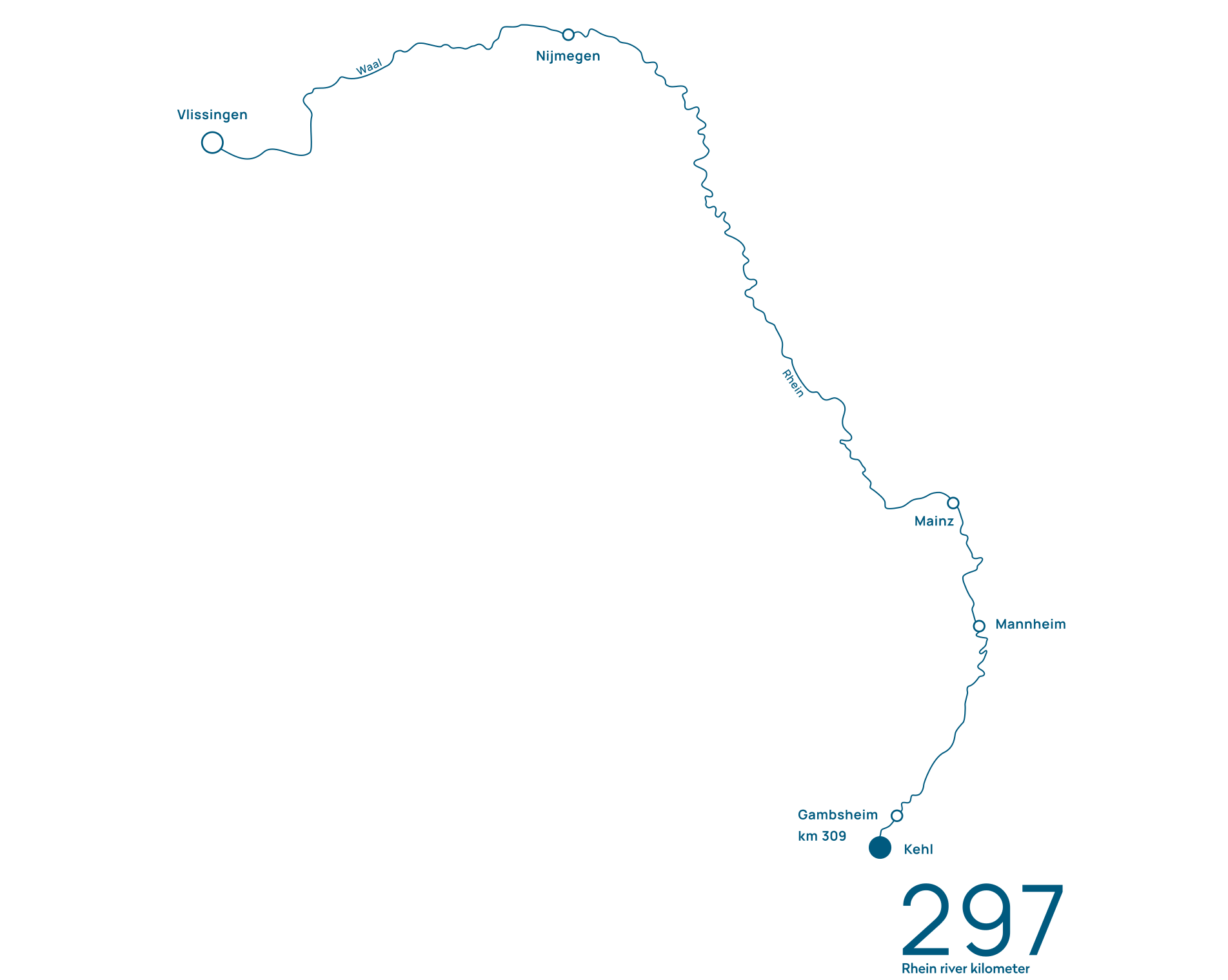
“This riverboat generates only a third of the carbon dioxide that using trucks would.”
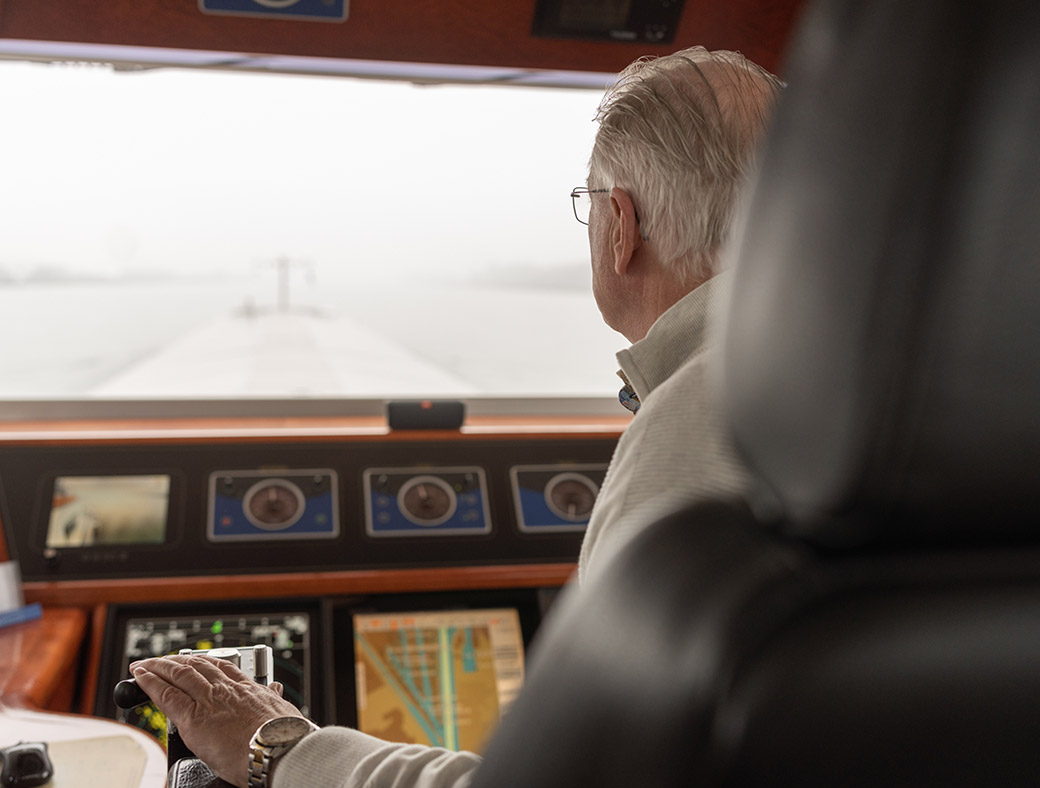

 792 kilometers is the distance between Vlissingen and Kehl
-
82 hours is the time that the Speranza needs to cover it
-
5 locks get passed on the way
-
2,000 metric tons of pulp are what the ship transports
Pulp from All over the World
The papermaking company does not settle for less when it comes to the material it uses. The pulp has to come from certified sustainable forestry and plantation management sources and meet a good number of additional criteria: “We produce specialty paper, which means we need special raw materials. There is great quality stuff in South America, but we also get pulp from Scandinavia, Spain, and Portugal,” Lienhard explains. The cargo the Speranza is carrying will end up being used, among other things, to make thermal paper that will later be cut into cash register rolls, for example. The paper needs to be especially smooth in order for the thermosensitive layer to adhere well. In addition, it needs to be strong and be able to easily and quickly move through receipt printers. The pulp on the boat should be enough for more than 750,000 kilometers of cash register rolls, which would be enough to go around the Earth almost 19 times.
Traveling on a Ship Sure Beats Traveling on a Truck
The Speranza’s 1,700 hp engine roars for a good 80 hours on the trip from Vlissingen to Kehl. During the voyage, it uses up 12,000 liters of sulfur-free diesel fuel similar to that used in cars. Two turbochargers make the engine more efficient, and its exhaust gas is purified in several stages. A selective catalytic reduction system injects AdBlue(TM) urea solution into the exhaust gas path, converting nitrogen oxides into water and nitrogen, both of which are harmless to the environment. After that, a filter separates the remaining particulate matter from the exhaust gas.
Nevertheless, the Speranza still releases some carbon dioxide. Lienhard casts a glance at the Rheinaue wetlands and points out that environmental aspects play an important role in his work. He has chosen a water route because it is the most sustainable option for transporting pulp: “This riverboat generates only a third of the carbon dioxide that using trucks would,” he calculates.
New Alternatives in the Near Future?
Mannak says he has been spending a lot of time exploring more environmentally friendly propulsion systems for his fleet, and lists some of the alternatives: Hydrogen takes a lot of energy to make, and the necessary fueling infrastructure is still missing. There are electric motors for small ships, but they are only good for short hauls. He is familiar with them from the canals of Amsterdam, the Dutchman says. “To complete a trip through the Rhine, we’d need so many batteries that there wouldn’t be any space left for cargo,” he explains while the Speranza fights against the current. The alternative where Mannak sees the greatest opportunities is drop-in fuels, which would be able to replace the diesel fuel used by the boat without any major conversions to the engine and consist of biodiesel, bioethanol, and HVO. For instance, “hydrotreated vegetable oil” production takes used grease from commercial kitchens or animal fat and converts it using hydrogen. And while burning biofuels still releases carbon dioxide, it only releases the same amount that was previously sequestered from the atmosphere by plants via photosynthesis.


From Ship to Site
Once the riverboard arrives in Kehl, it docks next to a massive gantry crane from which thick chains dangle. The roof opens up and the ship’s cargo is revealed: 1,000 pulp units, with each one consisting of eight bales that are a bit larger than a moving box, and each of which weighs around 250 kilograms.
Four workers climb into the cargo space and attach carabiners to the wires used to hold the bales together. The chains tighten up and the crane then lifts eight units simultaneously and swings them from ship to dock. Several forklifts hone in on the units and move the pulp to a warehouse. The trip continues from there to Koehler Paper’s Kehl mill right around the corner, where the pulp will be processed into thermal paper, decor paper, or flexible packaging paper. Or to Oberkirch 23 kilometers away, where the paper machine will be outputting playing card board and other products. Marc Lienhard and Matthijs Mannak say goodbye to each other genially and shake hands. They plan to soon travel together downstream to the Netherlands on an Interrijn ship, except just for fun and for longer than just one hour and a half.
