


Contact
General Inquiries
If you have any questions related to our products, the Koehler sales team will be happy to help. Just send us your inquiries using our contact form.
This e-mail service is intended exclusively for wholesalers, paper converters, printers, agencies, and graphic-design offices. We hope you will understand that we will not be able to respond to enquiries from private individuals.
Koehler Worldwide
For international product inquiries please contact our sales Partners.

Field of action 3
Blue4est® Makes Waves
This blue innovation has revolutionized the thermal paper market, but you can still hear people saying different things about whether it can be recycled. So to clear up any confusion, we conducted a large-scale real-life test together with SCHOELLERSHAMMER GmbH in order to confirm the product’s recyclability.
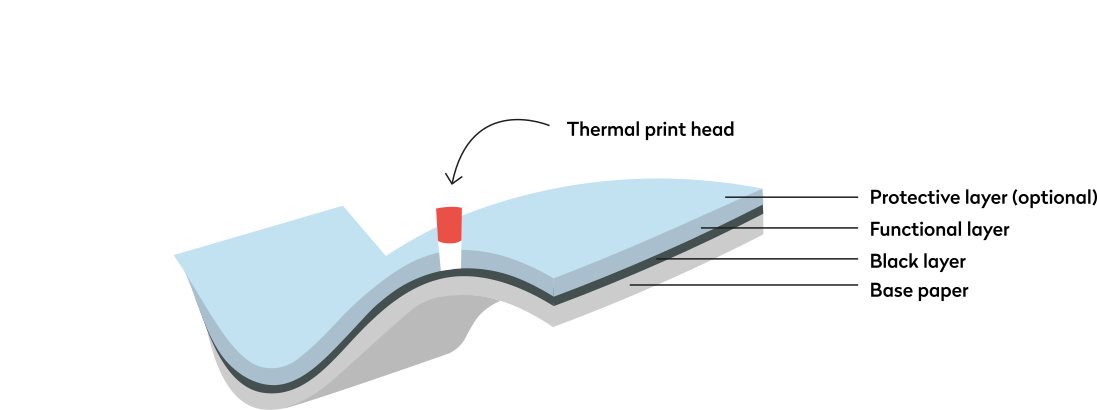
It had to be lightfast, free of chemical developers, and recyclable as wastepaper – with those requirements, 2010 saw us start a journey that would result in us inventing a new thermal paper product. Blue4est® finally hit the market in 2018: We applied a black layer on base paper made from certified pulp and then added an opaque functional layer on top. When a thermal printer uses this paper at a cash register, the functional layer turns transparent in specific areas, so that the underlying black layer becomes visible and the corresponding text is “printed.” Among other things, this means that, in contrast to conventional thermal paper, Blue4est® does not need any chemical color developers. As a result, it can be disposed of as wastepaper after being used, so that it can then be used as a valuable secondary raw material and the corresponding pulp fibers do not need to go to waste. It should come as no surprise then that retailers are thrilled about this sustainable alternative and that blue receipts keep replacing the old white ones at more and more supermarkets and drugstores. The German Environment Agency specifies that white thermal paper needs to be disposed of as residual waste, since it contains chemical developers that can disrupt the recycling process. Unfortunately, isolated media reports wrongly understood this to also apply to Blue4est® receipts, which naturally resulted in uncertainty among consumers. That is why we decided to test the thermal paper’s recyclability once again in order to clear things up.
More than 16 million t of waste paper were used in Germany in 2024.
A Sturdy Structure
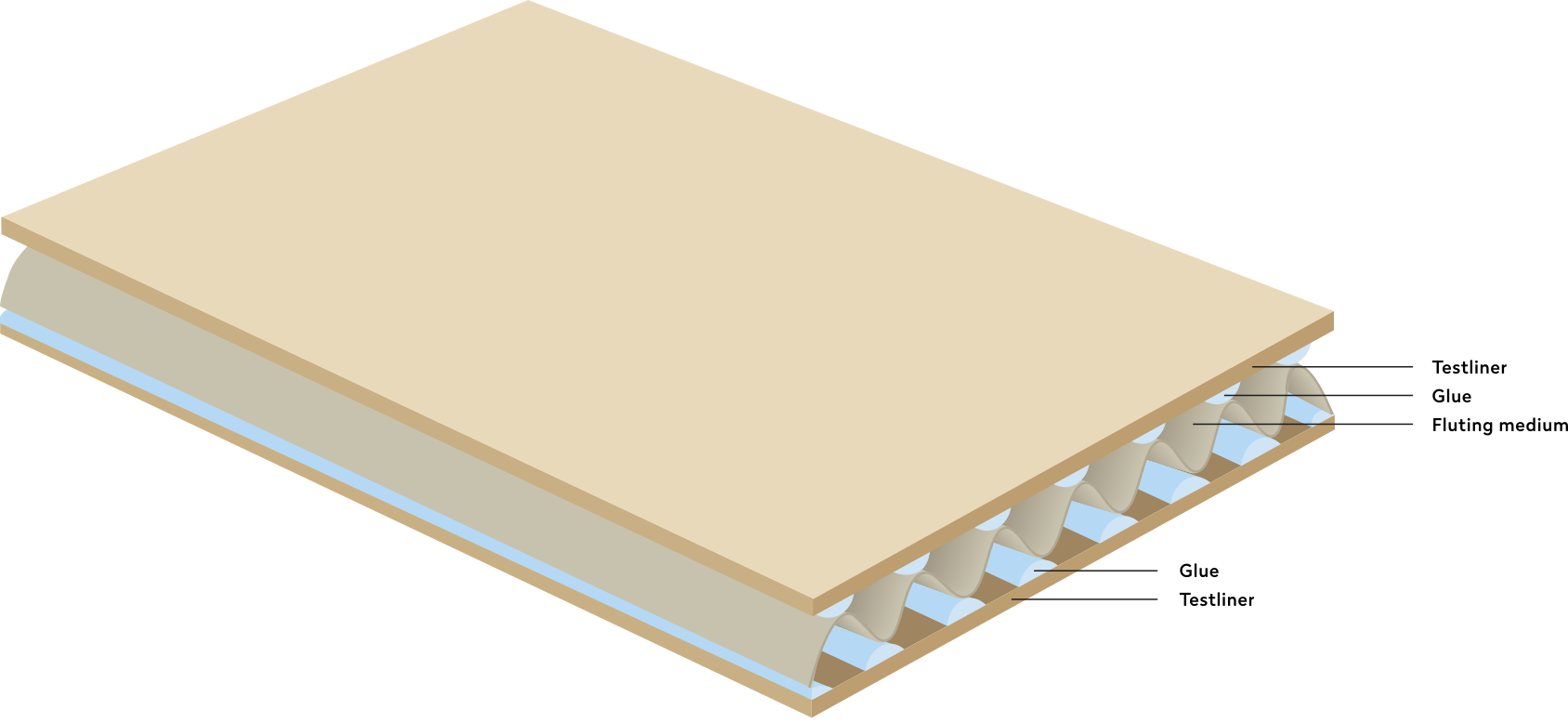
Paper is a material that is known for being highly recyclable. And this potential is being used: The recycling rate in Europe is around 79% – and even higher in Germany alone. Nearly 13 million metric tons of wastepaper were collected in the country in 2023, including daily newspapers, magazines, books, and cardboard boxes. More than half a million metric tons of those landed at SCHOELLERSHAMMER GmbH’s mill in Düren, Germany. For over 240 years, the company has been making paper, and for ten years now it has specialized in paper products that are processed into corrugated cardboard: Two layers of testliner, used as an inner and outer layer, enclose a fluted sheet of paper. The arches resulting from this fluting are similar to those found in bridges and cathedrals in that they are able to support large loads. At the same time, the lightweight paper structure means that there is a lot of hollow space, which acts much like a dunnage bag. Corrugated cardboard cushions impacts and falls during storage and shipping, ensuring that not only shoes and sweaters make it to their destination in one piece, but also sensitive goods such as wine bottles and computers. On top of this, many companies use their shipping boxes as ad space, which is why testliners with a smooth surface that allows for vibrant printed colors are a strong plus. This, of course, is different for the middle layer that gives this type of cardboard its name: “First and foremost, corrugated paper needs to be sturdy,” says SCHOELLERSHAMMER GmbH Head of Production Christoph Nahrath. He selects the types of wastepaper for the corrugating media accordingly, as the company only processes recycled materials.
How it works
Blue4est® thermal paper
Testing, Studying, Recycling
The Head of Technical Customer Service for New Developments at Koehler Paper, Christian Huber, explains: “If we were to assume that all the thermal paper in German wastepaper is Blue4est®, that would make up a maximum of 0.7% of the total wastepaper volume.” Together with Christoph Nahrath, he planned a test in which the environmentally friendly thermal paper would be used in SCHOELLERSHAMMER GmbH’s fluting medium production operations. The experts agreed to add 2% Blue4est® to the wastepaper mix – that is, nearly three times as much as would be theoretically possible – in order to make the results speak for themselves.
The process is identical to the one used to make other paper: Water is used to turn the fibers into a slurry that is then dewatered on a screen, pressed, dried, and processed into rolls. For two entire days, the experts had 40 metric tons of fluting medium with added Blue4est® come out of the paper machine every hour in Düren. Subsequent laboratory tests then confirmed what was already visible to the naked eye: The paper that was produced had zero anomalies, and all parameters – including coloration – fell within their normal variation range. Huber was not surprised: “The black dye goes where the water goes.” And that applies to all processes, including de-inking.

“Thermal paper makes up a maximum of 0.7% of the wastepaper in Germany.”
Christian Huber, Head of Technical Customer Service for New Developments at Koehler Paper
How corrugated cardboard is made

 Founded in 1784 in Düren
-
280 employees
-
Products: Hammerliner, Hammerflute, Twinhammer,
testliners, and corrugating medium
-
Two paper machines that produce 1,500 kilometers of paper
a day each
-
Annual production >500,000 metric tons of corrugated
cardboard paper
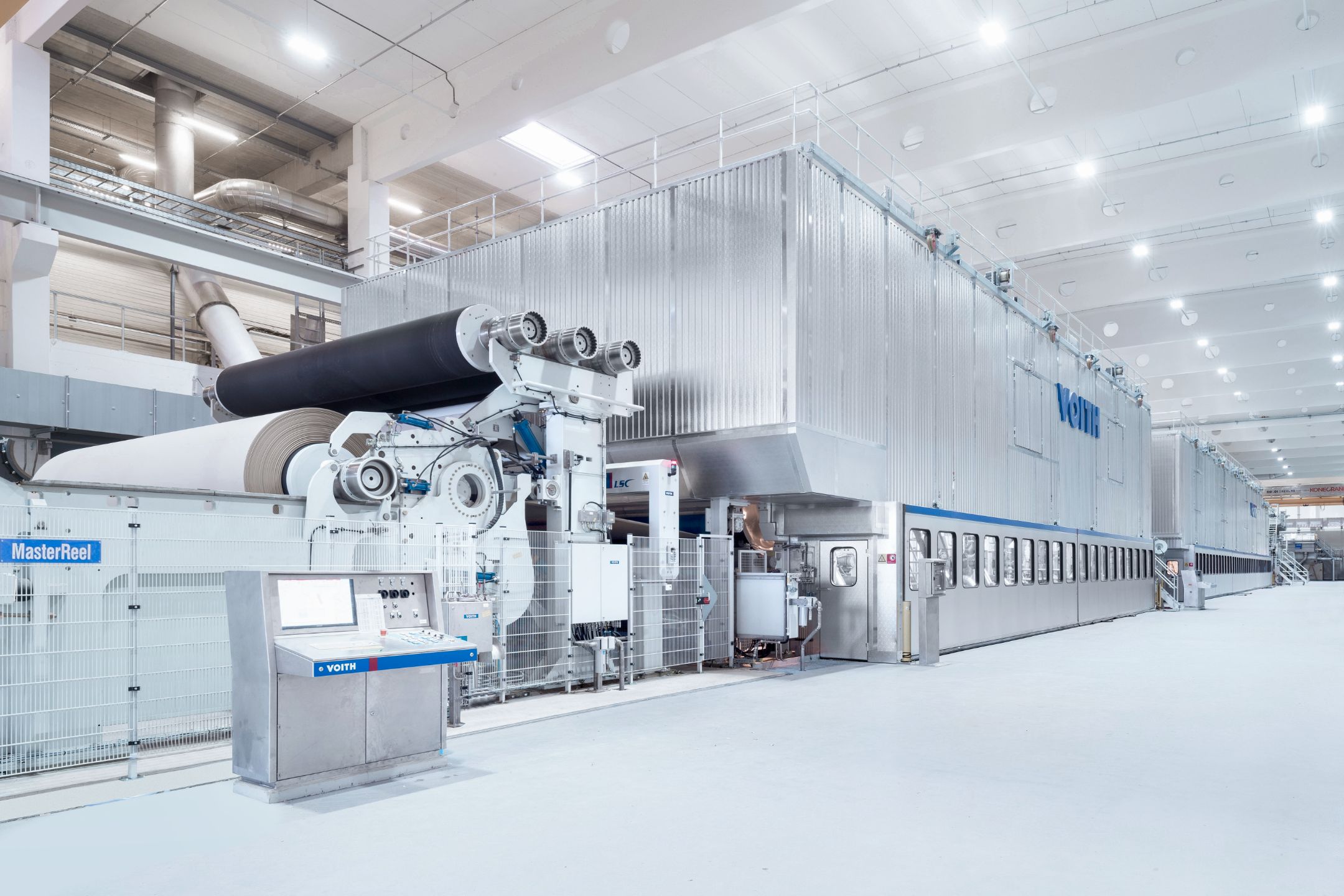
production operations use cutting-edge technology.
Wash Cycle for Waste Paper
De-inking, as the name implies, means removing printing ink from paper. To do this, companies in Europe normally start by dissolving the paper in water and stirring it vigorously while using added chemicals to release the color particles from the fibers. After this, air is blown in so that the color particles form a thick froth on the surface that can be skimmed. The fibers obtained this way are used as a raw material to make recycled paper. Testing found that, during de-inking, the pigment from Blue4est® paper does not get removed into the aforementioned froth, but instead, and as expected, goes where the water goes. Accordingly, companies that produce white recycled paper are advised to select wastepaper grades that are unlikely to contain any Blue4est®.
Blue4est® – Perfect for Fluting
Corrugated cardboard paper is predominantly gray or brown. This means that the production process used by SCHOELLERSHAMMER GmbH does not need de-inking, and that pigments in wastepaper are simply processed together with everything else. In addition, and interestingly enough, the Blue4est® added to the recycled paper caused the water in the paper machine loop to become darker at first, but quickly returned to its original color after the test, as Nahrath describes: “The pigment didn’t affect anything in our wastewater treatment plant and ultimately ended up in the sewage sludge flocs.” He goes on to summarize the results: “There was simply no difference whatsoever in comparison to the product we normally make. In other words, Blue4est® paper can be recycled into fluting medium with zero issues.” This is great news for consumers, who can confidently dispose of Blue4est® as wastepaper knowing that it can be seamlessly incorporated into the recycling stream used to make corrugated cardboard paper, for example.


“Blue4est® paper can be recycled into fluting medium with zero issues.”
Christoph Nahrath, Head of Production at SCHOELLERSHAMMER GmbH